Optimal Design for Steel Roofing in High-Humidity Environments: Engineering Solutions
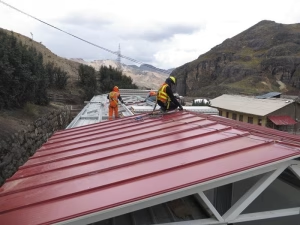
For engineering projects in high-humidity regions (Relative Humidity > 75%), the most effective roofing steel system integrates a high-build fluorocarbon (PVDF) or High Durability Polyester (HDP) coating over a Galvalume (Aluzinc) substrate, specifically coupled with a factory-applied non-woven anti-condensation layer. This system-level approach prioritizes chemical barrier integrity and moisture phase-change management over simple material thickness, ensuring a service life exceeding 20 years without structural oxidation or coating delamination.
Which Protective Coatings Perform Best in High-Moisture Environments?
| Performance Metric | HDP (High Durability) | PVDF (Fluorocarbon) | PU (Polyurethane) |
|---|---|---|---|
| Humidity Resistance (1000h) | Excellent (No Blisters) | Superior (Stable) | Moderate |
| Salt Spray Resistance | > 1000 Hours | > 1500 Hours | > 800 Hours |
| Chemical Stability | High | Highest (Kynar 500) | Moderate-High |
| Typical Application | Inland Industrial Regions | Coastal & Tropical Zones | Cold Storage Env |
Engineering Design Logic for Effective Moisture Management
Successful roofing in humid regions must address more than just surface protection; it requires systemic moisture control. At Baowu-Steel, we emphasize three critical engineering pillars for durability:
- Anti-Condensation Layers: In regions where high humidity meets rapid temperature drops at night, “indoor rain” from roof condensation is a major risk. Integrating a factory-applied non-woven felt on the steel underside absorbs moisture during peak humidity and releases it via evaporation, protecting internal structures from localized corrosion.
- Enhanced Back-Side Protection: Most steel roofing failures in humid climates occur from the underside out. While standard sheets use a 5μm back-coat, engineering for high humidity requires a minimum 10–12μm high-build epoxy back-coat to resist the micro-environment trapped above insulation layers.
- Pressure-Equalized Ventilation: Proper ventilation design is mandatory to reduce vapor pressure under the roofing sheets. Utilizing ventilated ridge caps and eaves ensures a continuous air-flow path that accelerates the drying of the roofing assembly.
What are the Material Selection Guidelines for Humid Industrial Projects?
To ensure project longevity, engineers must select materials based on the specific humidity source and chemical presence:
- Tropical Coastal Environments: Specify PVDF coating (min 25μm) over an AZ150 Galvalume substrate for maximum chloride and UV resistance.
- High-Humidity Industrial Plants: For facilities like paper mills or laundry plants, HDP coatings with enhanced thickness provide a superior cost-to-performance ratio for chemical resistance.
- Corrosion Allowance Design: In high-moisture zones, the thickness of the steel core is less critical than the “sacrificial” coating mass (min Z275 or AZ150) to prevent edge rust.
Compliance Verification and Durability Standards
Baowu-Steel ensures every roofing system for humid regions meets international performance benchmarks:
- ASTM D2247 Humidity Testing: Our coating systems undergo 1000+ hours of continuous humidity testing without blistering or loss of adhesion.
- MTC Transparency: All materials are supplied with Mill Test Certificates verifying the exact coating mass and chemical heat number for total traceability.
- Environmental Adaptability Audits: We provide engineering support to match specific local humidity data with the optimal coating chemistry.
Conclusion: Selection Logic for Humid Climate Roofing
IF the project location has an average RH > 80% or is within a tropical rain belt, THEN utilize PVDF-coated Galvalume with an integrated anti-condensation felt.
IF the facility has high internal moisture but is located in a temperate zone, THEN utilize HDP coatings with an enhanced 12μm back-side epoxy lacquer.